
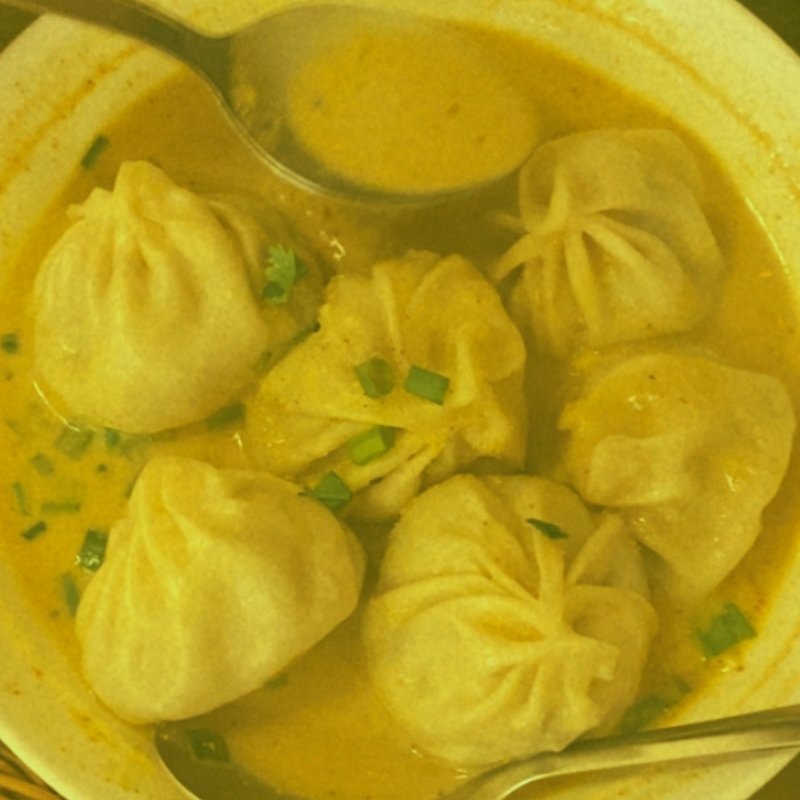
My mom craves jhol momo like any child would crave candy. Her eyes light up and her sharp, loud voice softens into a somewhat demanding request. Suddenly, the power dynamics shift between us. She is no longer the woman who single-handedly raised me with stubborn resilience. She becomes my child, asking me to make a good bowl of jhol momo, returning home full of hope that her craving will be answered.
The irony is that she has never known how to make momo. She knows it in theory but fails every time she tries. She doesn’t know how to knead dough, roll it into perfect circles, or wrap with little braids that shape it into something you can proudly say, yes, these are momo. Cooking wasn’t her forte. She never mastered continental dishes, huge Newari feasts, or the kinds of spreads from my tradition that fill a dinner table with pride.
But she knew enough. She knew enough not to let us starve. She knew enough to satisfy our hunger. And it’s not like she makes unappealing food she makes delicious food, but not in varieties. Daal, bhaat, aaloo masu, dhido, titey: simple, steady meals that showed up every day. She might not have given me variety, but she gave me the certainty that I would never go to bed hungry. My world of food was small and homely.I had never tasted a burger or pizza until eight grade. It was only when I started hanging out with my friends that I was introduced to the world beyond my mother’s kitchen. The only food we shared outside our home, the only hotel ritual we had together, was local jhol momo.
After SEE, I started experimenting in the kitchen, which later Covid’s lockdown pushed a little more. Week after week, I began exploring my mother’s kitchen, cooking something new, a small feast for both of us. Pastas, pizzas, burgers, curries. She enjoyed it all, but nothing made her request a second time except a good homemade pork momo.
It takes me almost four to five hours to make momo. I start with kneading the dough until my arms ache and let it rest while moving to the meat, mincing the fatty pork by hand on our chopping board for a good amount of time. I mix it with spices and let it marinate well, then move to rolling out the dough wraps. I wrap the momo in big, generous pieces exactly how she likes it. I set the momo steamer, frying leftover bones for a while, then adding water for broth, seasoned with nothing more than salt, black pepper, timur, and green onion leaves. For the jhol achar, I fry tomatoes, garlic, and dried chilies, then grind them by hand on the silauta and add water accordingly on the pan.
And she finishes it in no time. A bowl that takes me hours disappears within minutes, leaving only her satisfied smile. Afterwards, she happily washes the mountain of dishes as if it were her unspoken way of saying thank you.
Now, when she looks at me with childlike anticipation, waiting for that one good bowl of jhol momo, I see the strange reversal of our lives. She once fed me survival, and I now feed her indulgence. She once taught me how to endure, I now teach her how to delight. I feel we are the same person, but moments like this remind me of the small differences shaped by our lives. She was raised in scarcity, and I was raised in the abundance she created. That’s why she carries survival instincts, always farsighted, always worried about tomorrow while I lean more toward enjoying the present, savoring flavors and moments without neglecting the future entirely. And in simple times like this, in a bowl of momo, I realize that the love we give and show to each other has simply changed forms. Once she filled my stomach so I could grow, and now I fill hers so she can rest.