
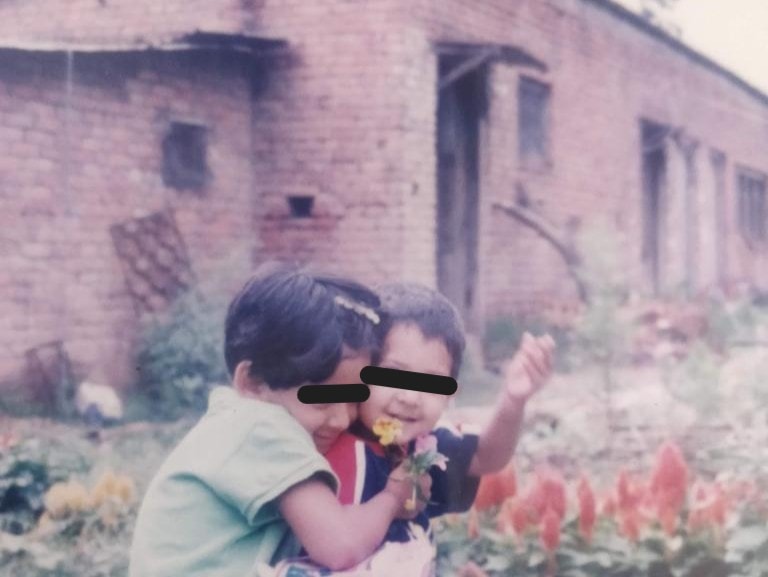
A lone house stood atop a small hill on the outskirts of Kathmandu. The valley below was mainly open fields of rice or mustard, depending on the season, with a few houses sprouting like weeds amongst the greenery, a clear view of the sky in all directions, with sparse clouds glimmering in the evening sun.
Tracing your eye through the dirt road that ran through the valley eventually led to an immense bamboo grove, atop another hill. A shimmering light would cut through the shadows of the leaves, not meandering like the dirt roads that led there; the shining light revealing a golden headdress of the Kapan monastery. Far off in the distance, tall hills lined the horizon, with even taller mountains sitting like shiny jewels above them. In some cold winters, these hills would be sprinkled with snow, and the jewels adorning them shining even brighter than usual.
The house did not stand alone on the hill. Eucalyptus trees, tall and white, looked down on it, along with the hawks that would nest high in their canopy. Higher still, vultures soared on warm air currents in the skies, on the lookout for the dead and decaying. Lapsi trees with thousands of sweet and tangy lapsi; bountiful for our family to share with the birds, the rodents, and the rest of the critters in the undergrowth. Along with it stood the fruiting trees of mango, litchi, grapefruit, guava, pear, and persimmon, bringing together creatures from far and wide, from the Macaques from the east to the Parakeets from the south.
As the light of day faded, Jackals howled to announce the coming of dusk, along with the flutter of hundreds of bats – some flying back to hang upside down for the night, others crawling out of crevices unseen to hunt insects in the dark. As the entire human world seemed to quiet down, a city of creatures would begin its day, its deafening orchestra on full display. Varieties of bugs of minuscule sizes roaring as loud as lions, for back then, the night belonged to them. Garden snakes slithered in the bushes, hoping not to run into the mongooses heading back to their burrows.
As the shed doors were latched in the anticipation of the dark, the cows settled down, their last bellows fading with the light. The distinct smell of dung filled the air, pungent but a welcome change from the monotony of the wind that blew over the paddies, bringing with it the sweet smell of the seasonal crop.
Although fully equipped with electric appliances, candlelight and torches blazed into the night, as frequent power cuts brought with them a sense of welcomed encroachment of nightly serenity. The power cuts may have brought darkness into our homes, but they let the night sky shine bright with stars. When dawn broke, fog covered everything as far as the eye could see, painting the world a mysterious grey. Curiously walking through it, rubbing my eyes in the morning, I always felt as if I were walking into a cloud, the clothes on my back glistening with dew. Our breaths would fog up, and we would pretend as though we were smoking like adults; the clouds escaping our lips intensified with hot tea.
Although the houses were sparse, there always seemed to be numerous children to play with. Still, the open landscape felt so grand for us, full of possibilities for adventure. I remember setting out on make-believe quests, retracing steps to find all the spots our family had buried cows and dogs over the years, the mounds of Earth now reclaimed and their memories returned to the land.
Kathmandu has changed so much now. I don’t remember the last time I saw a handful of stars together in the night sky. Now it seems though the celestials have severed their ties with us, punishing our disregard for one of their own, the Earth. The air feels different – polluted, dirty, heavy with the burdens of those who have flocked to it for its promised prosperity.
I wish I had more pictures of that corner of Kathmandu where I grew up. Proof that those moments truly existed, something that immortalizes the pristine condition as I remember from my childhood. My home no longer resembles my memories in any way, shape, or form. Without the solid evidence of photographs, my own mind scrutinizing the authenticity of my recollections, in the face of an unrecognizable, changed landscape.
I see glimpses of the past now and then in old albums that my parents have kept. Yet, all of these pictures featured people: my family, guests, new children, and old friends. Focused on ourselves, our faces, expressions and actions, the surroundings merely a backdrop. The home, the valley, the trees, and the green were just an afterthought; their beauty undermined, undervalued, and underappreciated, never center stage, taken for granted, overshadowed by the unimportant things that consumed us for any given day.
Sometimes I wonder if that is what led us here – an underappreciation for the places that nurtured us, for nature that created us, highlighted by the very fact that we never thought to capture its beauty in our photographs. Never important enough to us, never occurring to enshrine it. Its abundance felt infinite, its slow decline unanticipated. If I could capture images from my memory, it would be this corner of Kathmandu, as I remember it from early childhood – pristine and limitless.