
Carrying a paper holder with sheets from the last day, untouched and as blank as it was when I last put them in, I wait for the usual bus that takes over an hour to finally let me rest. The paper holder, which has low to no weight, today feels as heavy as a boulder on my shoulder. The blankness in those sheets carries twice as much weight as the holder itself. One more day spent in college doing nothing but brooding over my desk, staring at the mountain ranges seen from the window while having more than ten sheets left to complete by the next day. The absurdity of the situation makes me want to run far away, cry my heart out, and possibly never even return.
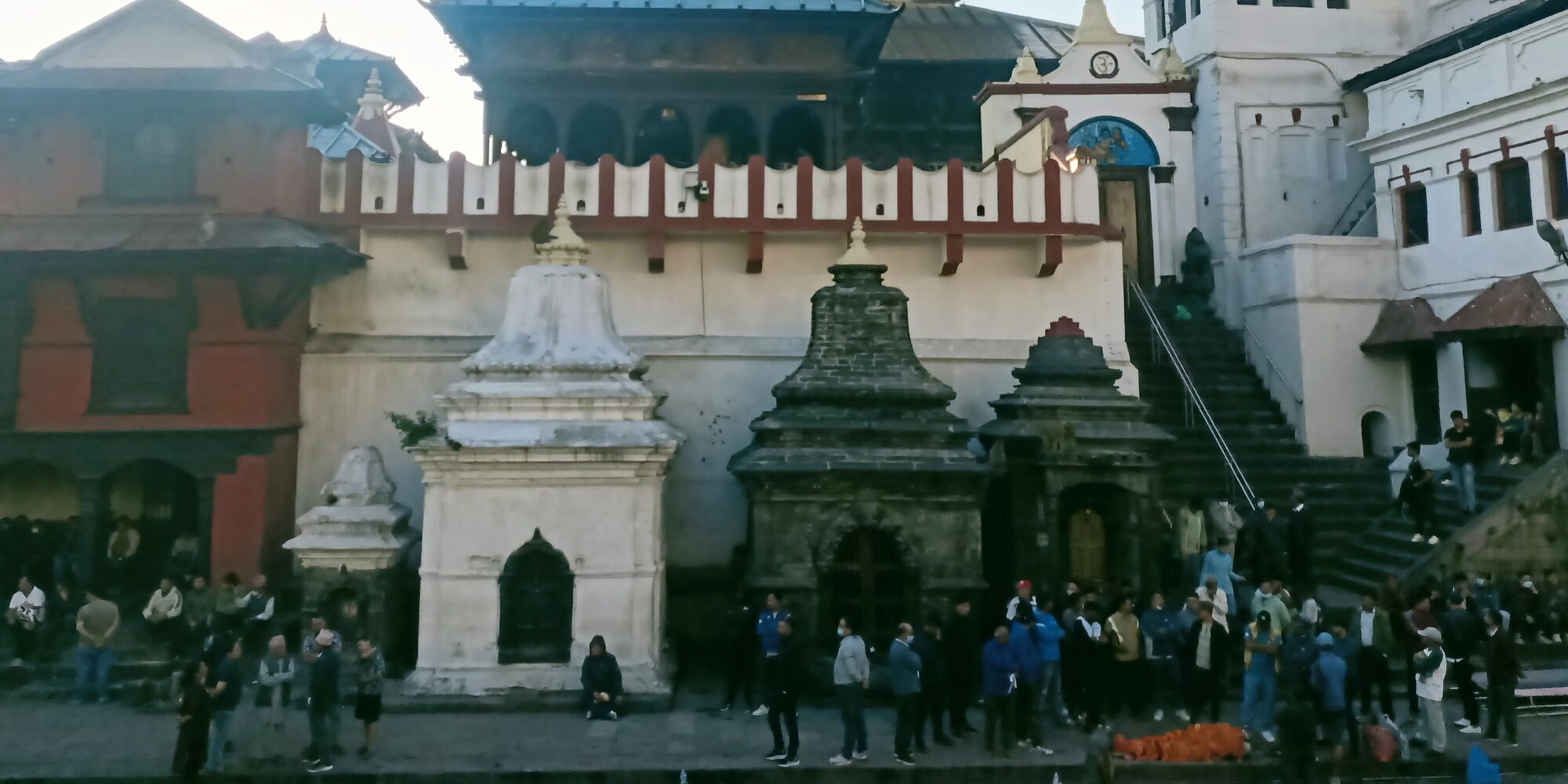
The bus arrives; its bright blue color catches my eye almost instantly, even from a distance. The bus that makes me prepare myself for an hour-long ride with nothing but music to keep me company today seems to be in a hurry and stops only once in Mitrapark. It stops for such a long time that a visit to Pashupati entices me. So, I get off the bus and head to the crematorium area of the temple. Perhaps it’s the never-felt-before religious belief or an on-the-spot decision to stall being home, but I assure myself that I’m learning history in situ.
The crematorium is where I always feel drawn whenever I’m made to go to Pashupati. I reserve a step very devoid of people to sit and view the surroundings. The spot is the best there is, for one can see both the devotees offering their prayers to gods and the mourners offering their last goodbyes to their loved ones. Like every other student trying to relate things to their study even when they are not studying, so as not to feel guilty that they aren’t studying, I try to identify the structures and the eras they were built in. But the procession right below the temple, on the edge of the Bagmati river, catches my attention more.
A body is brought in, closely followed by its relatives; some crying, and some soothing others while stifling their own cries. It feels insensitive to be sitting there looking at it play out as if it were a movie, but I stay nonetheless. The body is placed on the plinth as the people who followed disperse to their given tasks. Someone brings in clothes of red, orange, and yellow; someone lays out the logs; some gather around the body following the priest’s instructions, and it looks as if, for an instant, they are preparing for something exciting. The body that was once a living person is decorated with all these shades of red and yellow. The cries even stop at this point, as everyone remains focused on their respective tasks.
As the body is placed on the pyre, the cries resume. This time, louder than ever. On my side, Aarti preparations start. The cries of the family members don’t seem to hinder the process at all. Some people beside me hum the tunes of “What a lucky guy to be burned while Sandhya Aarti’s starting,” but I’m sure it doesn’t matter to this dead guy. Fire is cast on the body, and a grey cloud of smoke bellows from it, hindering every vision. The air around, for some time, smells of flesh. This magnifies the hurt. Even the people around me shed a tear or two.
After another 15 minutes or so, the people involved turn into viewers themselves. They remind me of Leo Tolstoy’s story The Death of Ivan Ilyich, which has a similar scene where the loved ones of Ivan Ilyich gather around his dead body, sharing the same existential crisis regarding death. Perhaps in each of their minds there is an image of themselves in the pyre. And perhaps they even revel in the process that their own dead body would go through before being cast into the fire. I know I do, and at that moment, I understand what Nietzsche meant when he said, “We have art in order to not die of truth.” The art that goes into the process of burning this lifeless body not only commemorates the person that the body once belonged to but also makes the others forget, if only for some time, the truth that this is a very flammable body we carry everywhere.