
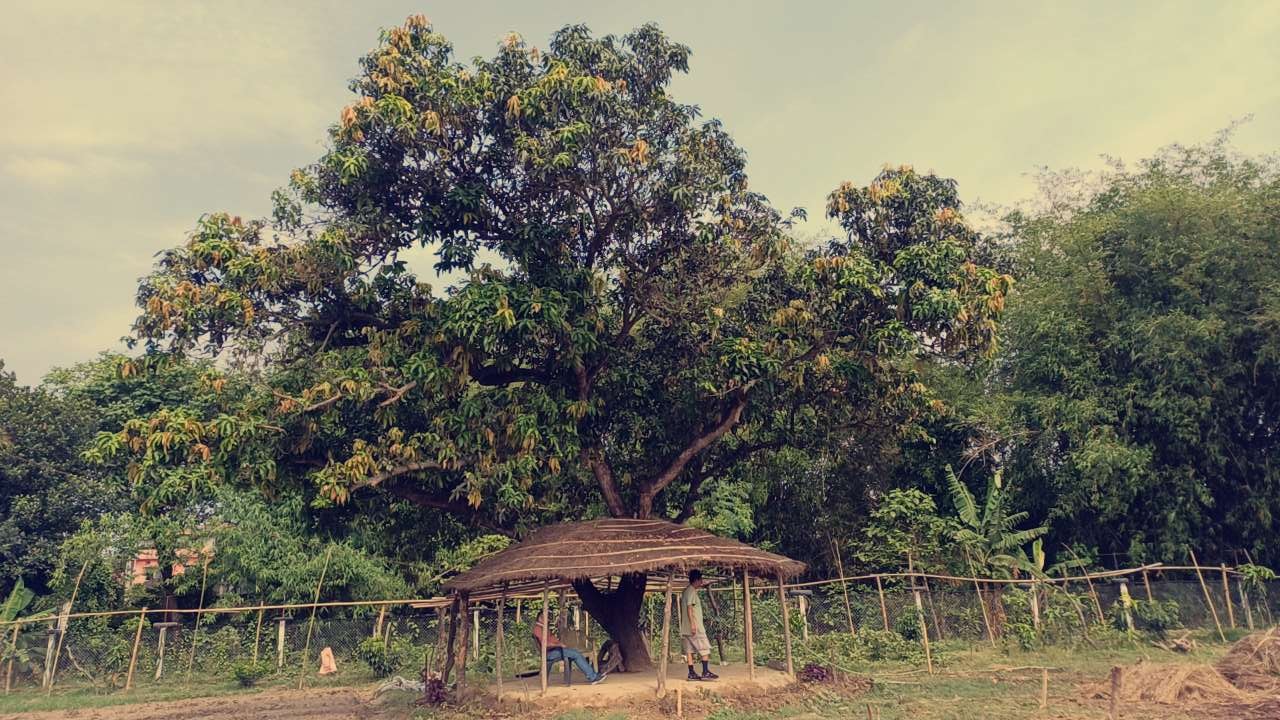
The aroma of freshly baked roti, warm and comforting, was the first thing Radha knew each morning.
But even before the scent truly filled their mud-walled home, she heard her mother's familiar cough, a persistent reminder of the dust that clung to everything in their Terai village.
Radha was only fifteen, yet her hands, accustomed to the endless cycle of planting and harvesting, already bore the faint lines of a life lived close to the earth.
Soon, those hands would be given in marriage, a path as pre-ordained as the monsoon rains.
It wasn't a choice, not truly, but a practical necessity, a way to ease the burden on her family, whose small patch of land yielded less each year, and whose latest loan from the cooperative felt heavier than the sacks of rice they carried from the fields.
The young men, like her elder brother, often spoke of the city, of factories and fleeting opportunities.
But too often, they returned, their hopes as parched as the summer fields, their pockets emptier than when they left.
Yet, when the evening lamps flickered, and the village gathered, there was a strength that settled over them – a shared resilience, a quiet understanding.
It was in the way they laughed at a simple joke, the shared stories of ancestors, the collective knowing that survival wasn't a solitary act.
In the Terai, life was a constant negotiation with scarcity, a testament to the unyielding spirit that bloomed even in the harshest sun, watered by the tears and sweat of generations.
The wind carried more than just dust across the open fields of the Terai; it carried whispers from beyond the porous border – whispers of easy money, of forgotten pain, of an escape that tasted like freedom for a fleeting moment.
For Ashok, twenty and adrift, those whispers were a siren song.
The city offered no jobs for his calloused hands, and the fertile land, once his family's pride, now barely yielded enough to quiet the gnawing hunger.
Days melted into a monotonous blur, punctuated only by the burning frustration of his idleness.
There were no community centers, no sports grounds, no libraries for boys like him, only the dingy backrooms where the air hung heavy with the scent of cheap liquor and the sickly-sweet smoke of ganja.
The border, a mere stroll away, was a ready pipeline.
What started with a shared cigarette of local cannabis, passed around to quell the boredom, soon escalated.
Then came the 'sleep medicine' – small, potent pills easily bought from a friendly chemist, no questions asked.
They promised oblivion, a temporary balm for the searing injustice of their lives.
Ashok's once bright eyes dulled, his robust frame thinning to a shadow.
His mother's pleas turned to tearful silences, his younger siblings learning too soon the meaning of shame.
The cheap highs provided a temporary escape, but the addiction was a relentless master, chaining him to a life far darker than the one he'd sought to flee.
In the Terai, the border wasn't just a physical line; it was a scar etched deep into the soul of a generation, a silent testament to dreams swallowed by desperation.