
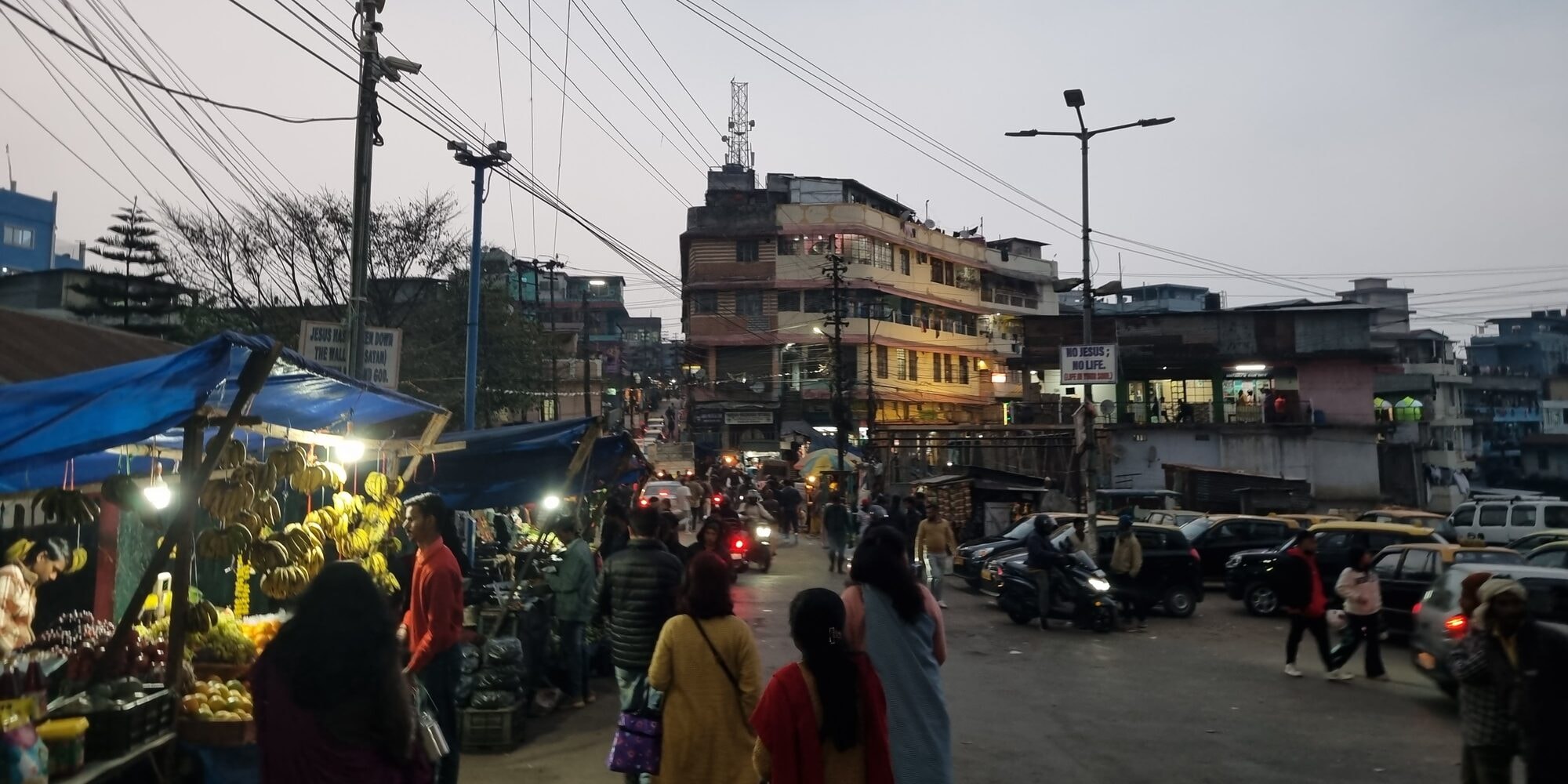
Ethnicity-based conflicts are not new in the northeastern states of India. Such events occur at regular intervals. One such conflict that broke out in Meghalaya, a northeastern Indian state, in the middle of 1987, shattered the hopes and dreams of many Nepalese people. An ethnic group in Meghalaya began voicing anger against the Nepali-speaking community throughout the state. The agitation reached its height when a tribal students’ organization in Shillong, the capital city of Meghalaya, came forth with a one-point demand: “Foreigners Go Back.”
This anti-foreigner movement swept across Meghalaya. As a result, many Nepali-speaking Indians and migrants from Nepal were rendered jobless and homeless. The stir played a decisive role in upsetting the life I was living and the life I had hoped to live. It compelled me to live as a refugee in a relief camp for a few days and eventually leave the place where I was brought up, forever. I had to start a new life in a new environment and find a job to support my parents. Not only that, I had no option but to change the stream of my studies. To be optimistic, it did pave a new path that led me to become the person I am today.
The demonstrations instigated by the tribal group became so severe that many Nepalese families living in different localities of Shillong, particularly those with a small Nepalese presence, had to abandon their hard-earned property and take refuge in government-run relief camps. The locality where we were staying had only three Nepalese families, including ours. The people there were kind and tried their best to offer us comfort and security. But they could not continue this for long. Youths from other localities began troubling us at night. I still remember how terrible the nights were. We really had many sleepless nights. The local headman, called gaunbuda by the Nepalese community, and other senior members were informed, but they expressed their helplessness. They suggested we move to a relief camp for a few days. We later found out that the headman had been given an ultimatum to make us leave.
On August 1, 1987, the headman and other community members visited us and told us about the arrangements they had made for our safe stay at a relief camp. The headman took responsibility for keeping our belongings and property safe. So, at about 4 p.m. that day, with heavy hearts, we left the place we had called home for so long. Vehicles arranged by the headman dropped us off at the relief camp. There were many such camps where thousands of Nepalese people were provided with food and shelter. We were taken to the Gorkha High School relief camp. Upon arrival, the headman and other neighbors who had accompanied us assured us they would try their best to bring us back home, and then they left.
Life in the relief camp began. The classrooms of the school were crowded with people, and the football ground was filled with cows that families had brought along. Most Nepalese in Shillong were dairy farmers. Each person in the camp had a painful story to share. Fourteen days passed. There was no sign of normalcy returning. News of killings, extortion, and stabbings was rampant. Gradually, I started to lose hope of ever returning to the place where I had spent my childhood. Given the escalating violence and uncertainty, my parents and relatives made the difficult decision to relocate to our ancestral home in Nepal. After making the necessary arrangements, all of us, except my father and a younger brother, left for Tansen, Palpa, in the Lumbini Zone, our home district.
Life in a new environment began. At first, it was quite difficult for me to adjust to the new surroundings. The responsibility of taking care of my mother and two sisters fell on my shoulders. We went through very hard times. I was in such a confused state of mind that I could not decide what to do to make our life more manageable. Sometimes, I missed Shillong and thought of going back. I called my friends and relatives, but they said the situation was getting worse every day. I had to do something. Life here in Nepal felt new and unfamiliar. People laughed at how I spoke Nepali because it was different from the dialect spoken there. A relative helped me learn to speak, read, and write Nepali properly, and soon I began to feel more comfortable.
I couldn’t just sit at home doing nothing, my father’s small income was not enough for our needs. So I started looking for a job. The only work I was eligible for was teaching in an English-medium school. I visited three schools, and one in Tansen offered me a position. I joined in April 1988. Since my qualification was just HSLC, I was assigned to teach at the primary level. They offered a monthly salary of Rs. 450 (NPR). I accepted the offer and started the job. I admitted my youngest sister to the same school in grade 5. The other sister had already completed her SLC. I didn’t want her to work; I wanted her to attend college.
I still remember my first day as a teacher, teaching English to Upper Kindergarten students. It was such a difficult day! After a few weeks, I was called by the school’s founder principal and asked to teach English to grades 5, 6, and 7. My salary was raised to Rs. 1000, a good amount at that time. I then decided to pursue my Proficiency Certificate Level (PCL), majoring in English.
I went to Tribhuvan Multiple Campus, Tansen, where I learned that only Management stream classes were held in the morning shift. Other subjects were taught during the day. Since I needed to keep working, I had to give up the idea of studying English as a major. I joined the PCL Management stream.
Coping with the language of instruction was a major challenge. Except for English, all subjects were taught in Nepali, a language I was not yet fluent in. At that time, not a single prescribed textbook was available in English. I had to refer to multiple books just to understand the content and complete my assignments. I was the only student in the college writing papers in English. Somehow, I managed to get through the PCL exam. Afterward, I joined the Bachelor's program in the same stream at the same campus and completed it with similar difficulties. I was more comfortable with English and genuinely interested in teaching it, but the degree I had earned didn’t allow me to pursue that. I found myself in a dilemma.
Fortunately, that dilemma didn’t last long. I found out that Tribhuvan University allowed students to sit for single-major papers in subjects of their choice. I contacted a relative who was studying at the university. He handled the formalities, and I sat for the three major English papers for the Bachelor of Arts program and passed. By that time, I had been teaching at the same school for eight years and was looking for better opportunities. Friends and relatives suggested I would find a better job in Kathmandu. So, in 1995, I stepped into Kathmandu for the first time.
Kathmandu was entirely new to me. I stayed with relatives and started looking for a job. During my search, I happened to meet my former English teacher, Mr. William Harvey Laitflang, who had taught me at St. Anthony’s High School in Shillong, where I had passed my HSLC exams. Mr. Laitflang was now teaching at Ideal Model School, Jhamshikhel, and served as the Head of the English Department. I was thrilled to see him after so many years. When I told him about my job search, he arranged an appointment with the school’s principal. I met him, and the English teaching position was finalized.
My work at the school was highly appreciated. As a result, I was offered the opportunity to pursue a Post Graduate Diploma in ELT at Kathmandu University’s School of Education, with fifty percent of the tuition covered by the school. While pursuing my PGD, I came into contact with Dr. Jai Raj Awasthi and Dr. Govinda Raj Bhattarai, who invited me to join their team assigned by the Curriculum Development Centre (CDC), Sanothimi, to write and edit Optional English textbooks for grades 9 and 10. This involvement paved the way for me to become a member of the English Subject Committee at CDC. As a committee member, I helped design and write various ELT-related materials published by CDC.
After completing my PGD, I joined the MA English program at Patan Multiple Campus and earned my master’s degree. Because of my experience and qualifications, I was offered a teaching position at SOS Hermann Gmeiner School in Sanothimi. My passion for further education didn’t stop there. I went on to complete my M.Phil. in English from Pokhara University, and I hope my journey of learning continues.
Since then, I have had the opportunity to give back to the field that shaped me. I have worked as a lecturer at several institutions and served as Assistant Director at SOS Children’s Villages in Lumbini. Today, I teach at Tribhuvan Multiple Campus in Tansen, returning not just to a campus but to the roots of a life that was once uncertain.
Having grown up in a foreign land and faced many ups and downs, I now find myself in a position I once could not have imagined. The various incidents I’ve experienced and the different goals I’ve pursued as a student of multiple disciplines have left a lasting mark on me. No matter what has happened in my life, I still hold on to my hopes and dreams. I continue to work toward making them come true. I don’t know whether I will succeed, but I know I will never stop trying. It is said ‘The show must go on’. So, I will also keep on striving for the best that I can achieve. Things are turning out better now, and I hope they continue to do so.